





I. INTRODUCTION
Religious opinions, faith and follows are imperative in many common persons existence, lifestyle as well play vital role in creating communal and personal identities (M. Lipnicka; 2021). The concept of materiality or material culture without any root in culture is just ornamental reformation of religion. The inherent believes to origin, relation with birth land, keeping Christianity, Buddhism, Hinduism, and Islam are the largest and most prevalent religions in the world, and respectivelyhas experienced major variations and versions over time in response to community and cultural changes. Christianity has had a long and complicated history with many branches since its founding more than 2,000 years ago (Chebatarov et al, 2020). But their belief in the divinity of Jesus Christ and the reclamation of man through his death and resurrection (Bevins, 2019), other Christian religions have different religious practices, traditions, and interpretations over time found easy way to increase their population by large number of conversions. With these colonization mind-set and cultural adaptation, financial advantages become instrumental in the process of inculturation of Christianity in India. Historical events are there in worldwide that many countries – ideology has systemically suffered with subversion and last point with new religious belief with shadow of Christianity.
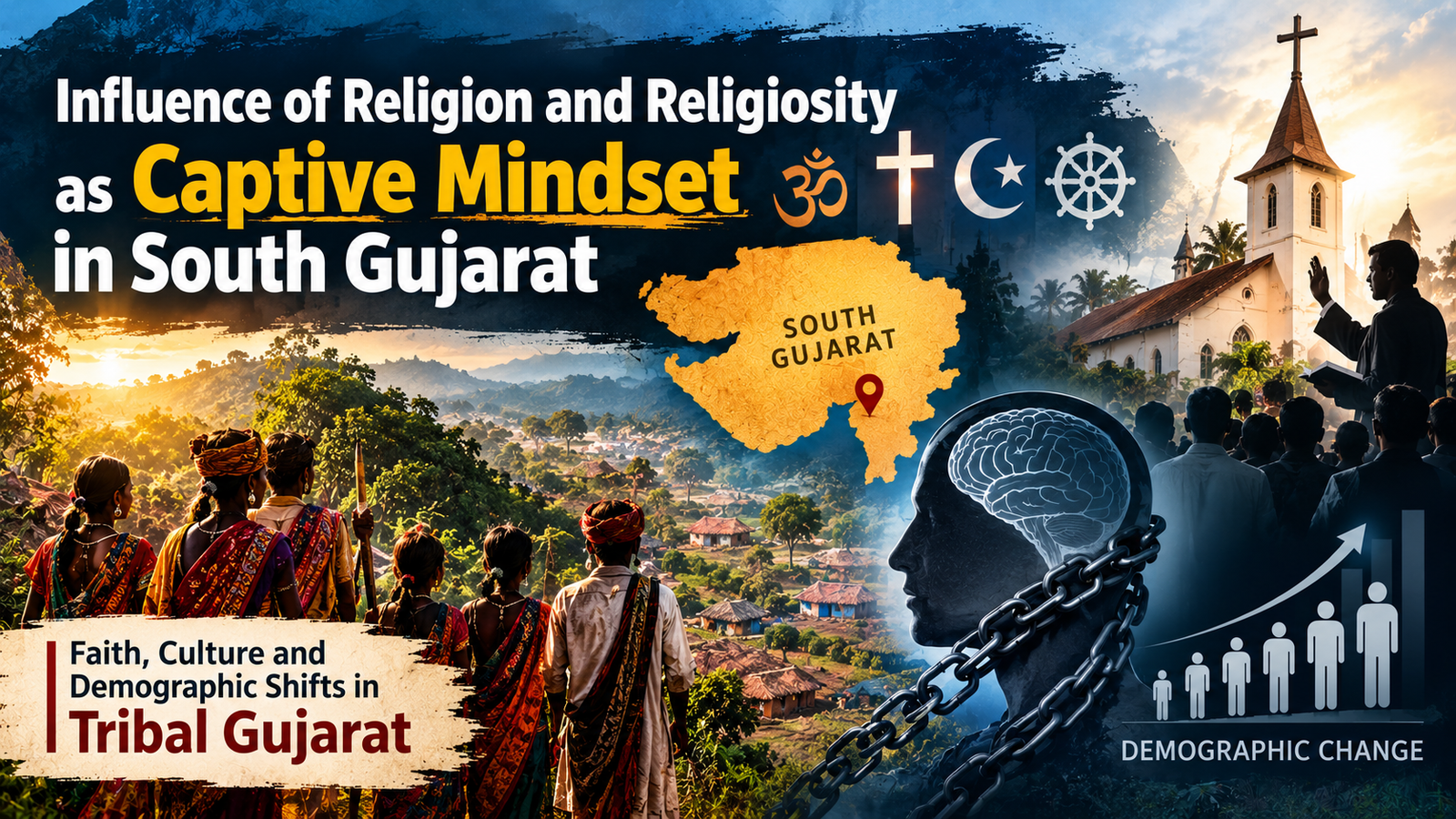
Three dimensions of religious support are examined in detail: emotional support from church members, spiritual support from church members, and emotional support from the pastor for conversion of religion to Christianity (N. Krause, C. Ellison, et al; 2001). Population ecology significantly understand the drivers of changes in abudance over the space, with demography more specifically related to how underlying vial rate of community development. When demographers try to predict changes in size of population, they mainly focused on four biological factors: fertility rates, death rates, birth rate and migration. But whole concept of biological dynamics changes in during religious groups, that considered as important fifth factor such as how many people choose to join and leave the religion, affiliation and non-affiliation with own religion (Tilley, 2006). The cultural changes in tribal region of Gujarat become very effective instrumentation for embodiment of the Christian belief expressed in the “things” that are indigenous to Indian tribal religious believe and tribal practices, most especially Hindu belief. That affects systematically to culture and later changes in demographic changes in overall indigenous Indian tribal “Adivasi” that now known as “Adivasi Christian”.
In early 1980s, the Chinese people are caught in space between collapsed traditions and seeking salvation in Christianity. Explanations for resurgence of religious fervour vary, such as the crisis of faith that resulted choose specifically Christianity and why Chinese converts in urban and rural areas actively proselytize and plant churches (J.Lee; 2007). The similar strategy have been applied in South Gujarat, where Adivasi-Janjati culture, values and traditions have been lost and new religious ideology proselytize among the people.
II. CAPTIVE MIND SET
Christian conversion in India, a captive mindset with certain attitudes of beliefs. Conversion itself is a ramification not just religious connotations but also covers the abandonment of one set of beliefs and rituals and transforming oneself to suit and be agreement with another set of beliefs rites and rituals. In religious and cultural sphere however religious conversion is a concept that could apply to any serious shift of behaviour from one type or another (Dawson; Lorne, 1988). A Christian convention in India, a very specific in Adivasi-Janjati or Tribal area in Tapi district is the most affected by a captive mindset. This conversion might refer to certain attitudes or beliefs that hinder spiritual growth or freedom of expression within the Christian community. The tribal people in their different communities like Kathud; Kunwar; Kotwaliya; Gamit; Chaudhary; Dhigale; Naik; Vasava; Bhil out of all the people of this community, the majority of people are polirized with Christian beliefs by “things”. These dynamic movement of faith has also been picture of the Church in general. In this context the Society of the Divine World’s Overseas Training Program (OTP) or Cross Cultural Program bears witness to the continuous process of the Church growth (Graph.1). The seminarians are not only sent abroad for OTP to learn culture, visit the country but they became good agents for changes in tribal area. They share their own experience of richness and comfortability among the Adivasi-Janjati. Hence, number of Diocese of Baroda Bishop Population is increasing in the area (Graph.2). Christianity in Tapi is not just a strategy but a temporal adjustment or an attempt propaganda and to fulfil it continuous infiltration of Bhisops, Pascals, that made insertion of Christian life in a cultural community where it deform the Adivasi culture in the region. Continuous increasing population of Adivasi Christian and Pascals observed in the district by replacing and dominating western culture leading to tribal culture by demographic change
II.I. DOGMA AND TRADITION
Captive mindset arises more when individuals have tradition of submissive, slave and follow the new tradition without
questioning or critically engaging with their faith and believes. This can limit exploration of different interpretation of scripture or theological concepts. The church and the cultures go hand in hand. The relation between the church and the cultures results in new culture enrichment that ends previous traditional culture into the life stream of peoples.
II.II. FEARING OF QUESTIONING
There may be a fear of questioning to authority or challenging established beliefs within or against Christianity. This fear may be inherent, lake of confidence, submissive mentality and or closed-minded approach. Some comparation done for changing the thoughts. For example, in Hindu, the famous utterance “Aham Brahma Asmi, I am Brahman, I am God” which is quite similar in Christianity by “Be like God” (Genesis 3, 5). But that was half-truth, the fact is Jesus Christ says: “I am the Way, the truth and the Life. No one comes to the father except through me” (John, 14,6). Due to lack of knowledge and confidence Adivasi peoples are not questioning of these narrations. They accept the statement given by Pascals and becoming enough enlightened. To these orthodox Hindu and cultural tribals, the Catholic gurus are preaching Christianity thinly veiled with agenda of conversion in a new approach that has been Silently approved by tribal and submissive people.
II.III. SOCIAL PRESSURE
Social pressure within the Christian community or broader society contribute to a captive mindset, where individuals feel compelled to conform to certain norms or expectations with if require creates conflicts with their personal convictions or spiritual journey. The ashrams are inter-linked with each other and used as network for New Age individuals (Graph.3). They also running schools, hospitals and other vocational training institution. The church is robe of many colours of the cultural variety on name of the one pilgrim people of “God”. It projected as indirectly a communication between language and cultures. Each of these brings its gifts to all who follows these cultural realities of different parts of the world (Bevans and Schroeder, 1991). In directly it imposes only an external adaptation along with integration in Christianity.
II.IV. CULTURAL INFLUENCES
Cultural norms and societal attitudes prevalent in India may also shape a captive mindset within the Christian community. This could include factors such as caste-based discrimination. Culture is design for living with a plan, consisting of a set of norms, standards and associated notions and beliefs. Culture also has own sharing with and within the social group, community that learning practices by the individual from the society. Culture is a system which organized into a dynamic, system of control. But the Church and Christian missions have always been engaged in inculturation. The church adapted the culture of particular region where it was spread, especially in the early centuries
A church historian rightly pointed out, “an uncompromisingly nationalist Indian Christianity was a tentative and uncertain development, a point that can be made for India as a whole” (Gerald, 1991). This tentative development become permanent establishment in Indian rural region because attraction of culture and financial influences (Graph a-g). This make demographic changes in tribal region. Church is that it never concentrated its establishments in a particular place but spread out largely in the rural and tribal region. Thus it became as a backbone of support to the rural population. In past, by learning and by studying and discussing many of the sacred Hindu texts, Roberto de Nobili was able to understand the depths of Hindu world of thoughts. And teaching Christian dogma based on Hindu philosophy (Bevans and Schroeder,2004; Baierlein 1995).
II.V. LACK OF CRITICAL THINKING
A captive mindset may be characterized by a lack of critical thinking skills or intellectual curiosity, leading to passive acceptance of religious teachings or practices without deeper reflection or examination. Because of lack of confidence tribals are never took part in arguing with cultural and demographic change. Some tribal communities have limited access to quality education also fear with languages barriers. Especially for tribal communities with district languages or dialects, can create difficulties in communication and interaction with mainstream society. That is one of opportunity for Christianity conversion, the sense of inadequacy and lower self-confidence among tribal individuals. Cultural polarization among tribals by showing popular literature and culture that reinforce feelings of inferiority and develop faith for new culture with attractions. Christianity itself supports many supernatural activities, habits but while comparing with tribal culture this part of it never exposed and even questions never been raised by tribals (Blanco-Sarto, P; 2021). Missionaries have always been ahead of their times and they always believed in giving the very best to tribal people. By providing this facilities leads to loss of cultural identity. Rapid inculturation in tribals communities adapt to mainstream cultures that loss of cultural pride and confidence in their heritage. Tradition and heritage is iconic growth of every tribal communities. Participations in various rituals as means of drawing closer to community but modern developments celebrates new age festivals with new rituals that resulting in unacceptable demographic change
III. CONCLUSION
Religion provides a very colourful part of religious end over and provide an opportunity for spiritual growth, and are also become instrumental in making community development but also encapsulating society. There is no necessary seriality between joining and conversion but that encapsulating society, culture, rituals responsible for mental breakdown or loss of identity. Christian India is still undeniable fact and it increasing its follower’s day by day, deculturing tribes. The present research justifies the postulate in the field of relationships between captive mindset, religiosity and lower confident peoples’ relationships. This may become more and more important in the process of building individual new decultured identity.