







Great Thunberg vs Vinisha Umashankar: Parenting, Faith & Climate
Greta Thunberg to Vinisha Umashankar: Parenting, Biblical Stewardship, and Indian Thought
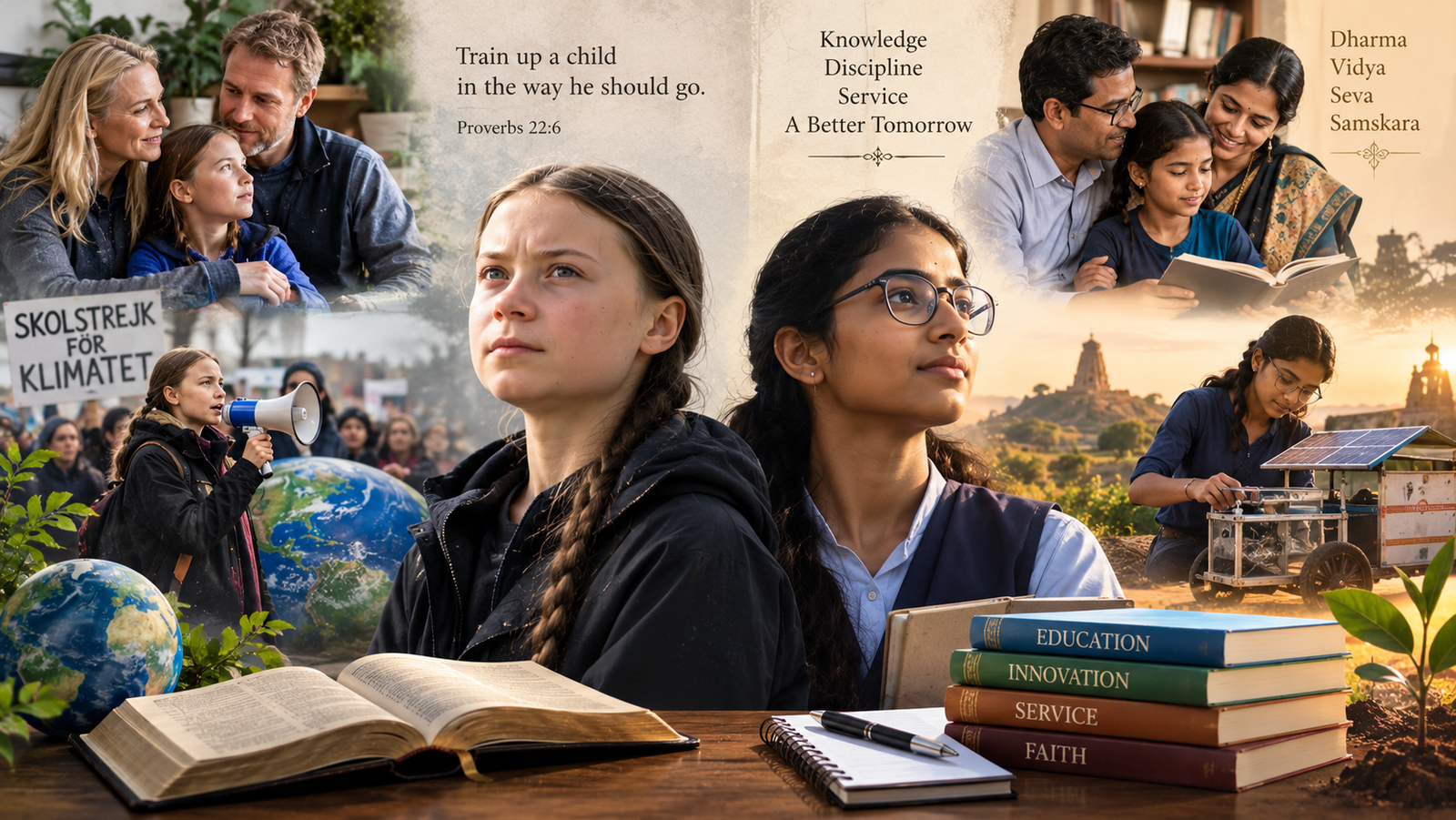
The contrasting paths of Greta Thunberg and Vinisha Umashankar (often misspelled Vanisha) are not only about climate strategies—protest versus practical invention—but also about the parenting that shaped them. One emerged from a progressive Western European household navigating personal crisis through activism. The other grew in a supportive Indian family that fed curiosity with books, science, and encouragement toward problem-solving. Framing these against Biblical ideas of parenting and Indian cultural-philosophical traditions reveals deeper differences in how children are guided toward responsibility, purpose, and the world.
Greta’s Household: Responsive Support Amid Crisis
Greta’s parents, opera singer Malena Ernman and actor-turned-stay-at-home father Svante Thunberg, raised her in a creative, culturally engaged Swedish home. The family faced significant challenges: Greta experienced depression, selective mutism, an eating disorder, and was later diagnosed with autism spectrum traits (described as high-functioning autism/Asperger’s) and OCD. She stopped eating, talking, and engaging for periods. Her parents responded by prioritising her well-being—adopting lower-arousal approaches, adjusting family life, and eventually aligning with her climate concerns. They became vegan, reduced flying (impacting Malena’s career), and supported her school strikes, though initially reluctant. Svante has said they acted more to “save their child” than to save the planet; activism restored her purpose and health.
This style is highly responsive and child-led. Parents listened, adapted their lifestyles, and provided logistical support (e.g., accompanying her on travels) while insisting she own the initiative. It reflects modern Western progressive parenting: emotional attunement, validation of the child’s feelings and agency, and willingness to restructure family life around a young person’s passion or distress. Critics sometimes question whether it risked over-identifying a child’s struggles with global catastrophe or placing a heavy public burden on a neurodivergent teenager. Supporters see it as compassionate enablement that turned personal darkness into public impact.
Vinisha’s Household: Nurturing Curiosity and Steady Encouragement
Vinisha’s parents—S. Umashankar, a business consultant, and U. Sangeetha, a science teacher—raised her in Tiruvannamalai, Tamil Nadu. From early childhood they noticed her fascination with science and mathematics, bought her books and encyclopedias, and took her to museums, parks, and historical sites. When she observed charcoal-burning ironing carts and researched the problem, they encouraged her to develop an alternative rather than merely discuss it. Her mother, as a science teacher, provided practical help. The family maintained a calm, supportive environment that balanced academics (she was a class topper) with extracurricular exploration. They accompanied her to COP26, proud but not the centre of the story.
This reflects a classic Indian middle-class parenting pattern: strong emphasis on education, disciplined curiosity, respect for knowledge, and channeling a child’s interests into constructive achievement. Parents act as enablers and resources rather than co-protagonists. The child is expected to study hard, manage time, and turn observation into tangible contribution—while remaining grounded in family and studies. There is less public narrative of parental lifestyle sacrifice or family crisis; the focus stays on the child’s innovation and optimism.
Biblical Perspectives on Parenting
Biblical teaching on parenting centres on intentional formation. Parents are to “train up a child in the way he should go” (Proverbs 22:6), bring children up “in the discipline and instruction of the Lord” (Ephesians 6:4), and model stewardship of creation (Genesis 1–2). Children are a heritage from the Lord (Psalm 127), to be guided with both love and firm boundaries. Authority is parental; the goal is character, wisdom, and responsibility under God rather than pure self-expression. Environmental care appears as wise dominion and care for the earth as God’s gift, not primarily as protest against systems. Parenting is oriented toward long-term formation of virtue, work ethic, and faith rather than amplifying a child’s immediate emotional response to global issues.
Greta’s parents demonstrate deep sacrificial love and attentiveness—qualities valued in Scripture—but the child-led intensity and systemic moral framing sit less comfortably with traditional Biblical hierarchies of parental guidance and measured stewardship. Vinisha’s upbringing aligns more readily with the emphasis on diligence, learning, and productive contribution, though it operates in a Hindu cultural context rather than explicit Christian faith.
Indian Thought and Family Values
Indian traditions (drawing from dharmic ideas, joint-family norms, and educational emphasis) stress samskara—formative impressions and disciplined upbringing. Parents and elders guide children toward duty (dharma), knowledge (vidya), and contribution to family and society. Curiosity is encouraged when channelled productively; emotional expression is often tempered by self-control and respect for hierarchy. Success is measured partly by academic and practical achievement that uplifts the family and community. Environmental concern frequently appears as practical harmony with nature, resourcefulness, and local solutions rather than abstract systemic confrontation.
Vinisha’s story fits this pattern closely: parents notice aptitude, supply resources, encourage research and invention, and celebrate results without making the child’s cause the family’s identity. Greta’s model—high emotional transparency, parental lifestyle conversion, and public confrontation—feels more individualistic and less hierarchical than classical Indian norms.
Critical Contrast
The differences are not simply “Western vs Indian” or “Biblical vs dharmic,” but in the balance of agency, emotion, and formation:
Agency**: Greta’s parents largely followed their daughter’s lead after initial hesitation; Vinisha’s parents guided and resourced her initiative within educational and family structures.
Emotion and crisis**: One household navigated profound personal distress by embracing activism as healing; the other appears to have cultivated steady curiosity without a public crisis narrative.
Goal of parenting**: Responsive empowerment and moral urgency versus disciplined enablement of practical problem-solving.
Worldview transmission**: Systemic critique and personal sacrifice versus local observation turned into scalable innovation.
Both sets of parents clearly loved their daughters and sought their flourishing. Greta’s family modelled radical solidarity with a child’s convictions. Vinisha’s modelled the quieter work of feeding a mind and expecting results. Biblical ideals lean toward intentional, authority-guided formation for wisdom and stewardship. Indian thought emphasises duty, learning, and harmonious contribution. The practical outcomes—global protest movement versus a working solar cart that helps street vendors—mirror these formative differences.
In an age of climate anxiety, the comparison invites reflection: Does healthy parenting primarily amplify a child’s moral outrage and public voice, or does it primarily equip the child with knowledge, discipline, and tools to solve concrete problems? The two young women show that different answers can both produce remarkable individuals. The wiser path may lie in combining the best of both—attentive love with purposeful formation.