






Biblical Accounts of Hagar and Bilhah Raise Urgent Questions About Women’s Reproductive Rights, Consent and Religious Authority
Ancient narratives in Genesis 16 and Genesis 30 bring renewed attention to the intersection of infertility, female servitude, reproductive control and the ethical interpretation of scripture.
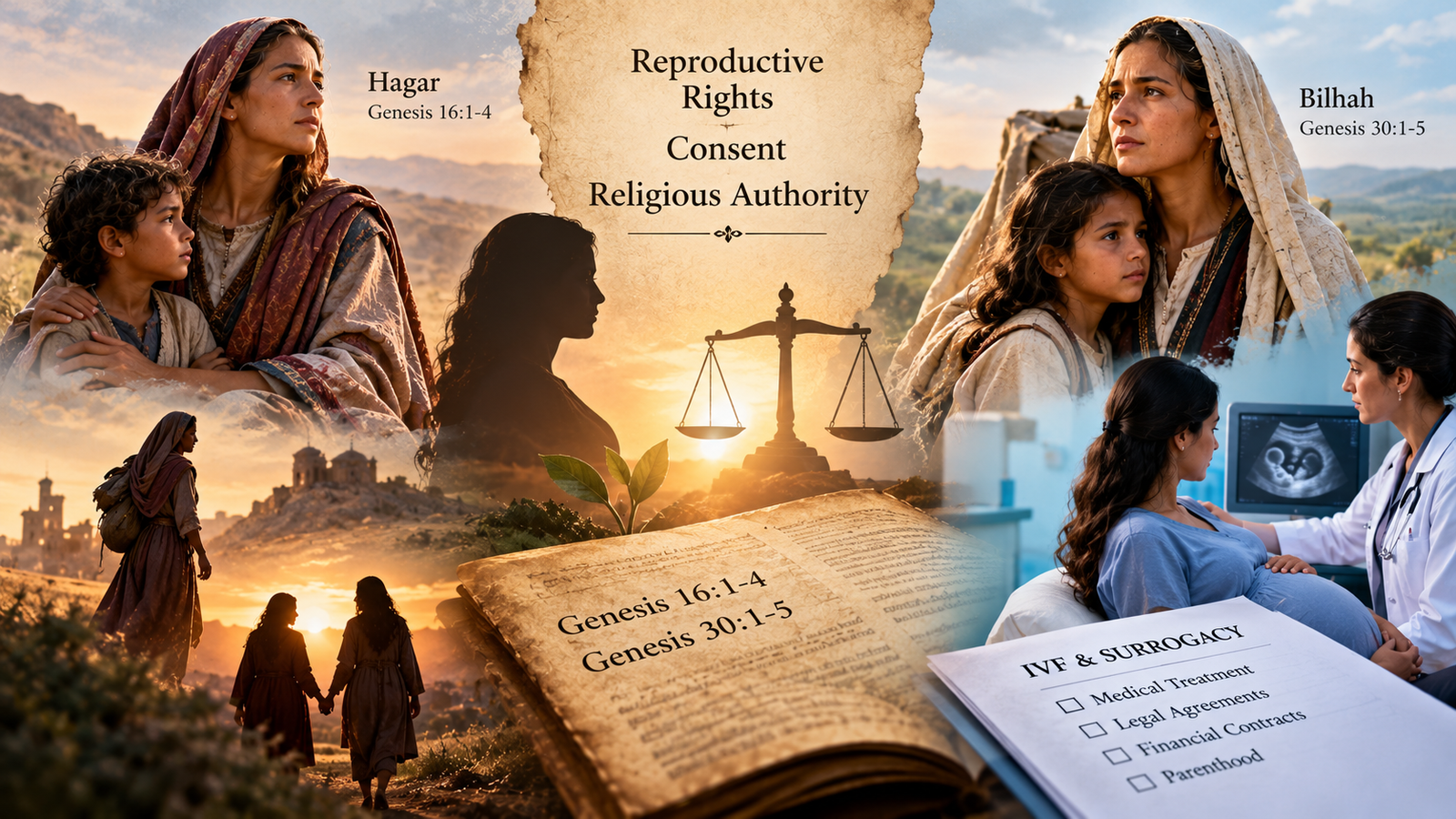
Two ancient biblical incidents raise questions that remain relevant to contemporary debates about women’s dignity, reproductive autonomy and the interpretation of religious texts. In Genesis 16:1–4 and Genesis 30:1–5, the Bible describes how Sarah and Rachel, unable to conceive at the time, arranged for their servants, Hagar and Bilhah, respectively, to have children through their husbands. These accounts offer a significant opportunity to examine the relationship between motherhood, social hierarchy and the power exercised over women’s reproductive lives.
The passages are particularly important because they describe situations in which decisions concerning reproduction are made within unequal household relationships. Sarah gives her Egyptian servant Hagar to Abraham, while Rachel gives Bilhah to Jacob. In both cases, the servants’ capacity to bear children becomes part of another woman’s efforts to establish a family. Yet the biblical accounts do not record Hagar or Bilhah explicitly consenting to these arrangements.
This absence raises an important ethical question: when a person occupies a subordinate position, how freely can that person determine what happens to her body? Although modern concepts of informed consent and reproductive rights developed in different historical circumstances, the question of whose wishes matter remains central to a critical reading of these passages.
Infertility, motherhood and social pressure
In the ancient social world represented in Genesis, motherhood was closely associated with family continuity, descendants and household standing. Rachel’s distress in Genesis 30 illustrates the emotional pressure associated with her inability to conceive, particularly in comparison with her sister Leah, who had children.
Sarah and Rachel’s desire for motherhood should not be dismissed or treated as inherently wrong. The critical issue is the means through which that desire is pursued and the unequal position of the women whose reproductive capacities become involved.
Hagar and Bilhah are not presented as socially equal partners in these decisions. Their positions as servants significantly limit their authority within the household. A critical examination must therefore consider the difference between the aspirations of those exercising power and the circumstances of those whose bodies are involved in fulfilling those aspirations.
The narratives also encourage a broader reflection on the social treatment of infertility. A woman’s inability to conceive should not be interpreted as a moral failure or as a measure of her personal worth. Nor should the desire for a child automatically override the dignity, welfare and autonomy of another woman.
What does the Bible actually say?
One of the most important distinctions in interpreting these passages is the difference between describing an event and prescribing a universal rule.
Genesis 16 recounts Sarah’s decision concerning Hagar, and Genesis 30 recounts Rachel’s decision concerning Bilhah. Neither passage establishes a universal command requiring infertile couples to involve servants in reproduction. Treating these accounts as mandatory instructions would go beyond what the passages explicitly state.
This distinction is essential to responsible religious interpretation. Biblical narratives contain descriptions of family arrangements and social practices from the ancient world, but the presence of a practice in scripture does not automatically mean that every aspect of it is intended as a moral example for subsequent generations.
The appropriate response is neither to ignore difficult passages nor to accept every described practice without examination. Instead, readers must consider historical context, narrative consequences, the status of the individuals involved and the wider ethical principles of their religious tradition.
Hagar and Bilhah: The women behind the decisions
A significant concern in both accounts is the limited space given to the servants’ perspectives when the reproductive arrangements are initially made. Sarah, Abraham, Rachel and Jacob occupy prominent positions in the decisions, while Hagar and Bilhah are primarily introduced in relation to their status within the household.
Hagar’s story, however, extends beyond her role in Sarah’s reproductive plan. In Genesis 16, she encounters a divine messenger in the wilderness. In Genesis 21, she again faces a crisis with her son Ishmael and receives divine attention. These episodes make her suffering and survival important elements of the biblical narrative.
Her story challenges readers to see her as more than a means of fulfilling another person’s desire for children. She is also a person whose experiences, vulnerability and relationship with God deserve consideration.
Bilhah’s narrative offers a different interpretive challenge because her own perspective is less fully represented. It would be inappropriate to assume that the text tells us everything about her wishes or feelings. Nevertheless, her subordinate status makes questions about agency and consent unavoidable in a modern ethical discussion.
Relevance to contemporary reproductive ethics
The accounts of Hagar and Bilhah also invite reflection on present-day discussions concerning infertility, surrogacy and reproductive technologies. However, ancient household arrangements should not be equated automatically with modern surrogacy, which can involve very different medical, legal and social circumstances.
The more meaningful comparison concerns the conditions under which reproduction takes place. Where a woman is threatened, compelled, exploited or denied a meaningful opportunity to refuse, serious ethical concerns arise. Where reproductive decisions are made freely and with appropriate safeguards, the circumstances are fundamentally different.
The biblical passages do not resolve every contemporary debate about reproductive medicine. They do, however, provide material for examining how social inequality can shape reproductive decisions and why the welfare of the woman carrying a pregnancy must not be overlooked.
The broader principle is that the desire for parenthood deserves compassion, but it cannot by itself justify the coercion or exploitation of another person.
Religious interpretation and ethical responsibility
These narratives also highlight the responsibility of religious leaders, scholars and readers to interpret scripture carefully. Isolating an ancient passage from its historical context can lead to conclusions that the text itself does not explicitly support. Equally, using religious authority to prevent ethical questions from being asked can silence those most affected by a practice.
A responsible interpretation should acknowledge the historical realities reflected in the text while examining them through broader considerations of justice, human dignity and the treatment of vulnerable people. Such an approach does not require dismissing the Bible’s religious significance. Rather, it recognizes that serious engagement with scripture requires careful reading and thoughtful ethical reflection.
The central issue is not whether Sarah and Rachel wanted children. It is whether the interests and experiences of Hagar and Bilhah receive adequate consideration when their reproductive capacities become part of another household’s plans.
A question that goes beyond the ancient text
Genesis 16 and Genesis 30 remain significant because they bring together the deeply human desire for children and the unequal power relationships through which that desire was pursued in the ancient world. Their examination encourages readers to move beyond a superficial reading and consider the lives of the women whose experiences are recorded in scripture.
The wider lesson is that historical description should not automatically become moral prescription. Religious texts deserve interpretation that considers their context, acknowledges the complexity of their narratives and takes seriously the dignity of every person involved.
Ultimately, these passages invite an important ethical question for religious and public discussion alike: when motherhood, family continuity or social authority becomes the overriding objective, how can the dignity and agency of the women most directly affected be protected?
That question makes the stories of Hagar and Bilhah more than accounts of ancient family arrangements. They are an opportunity for serious reflection on reproductive ethics, social inequality and the responsibility to interpret religious traditions without overlooking the humanity of the people within them.