





The Middle East is home to some of the world’s oldest Christian communities. Long before the emergence of many modern nation-states, Christian communities existed across regions that are today part of Egypt, Syria, Lebanon, Iraq, Jordan, Israel and Palestine.
These communities have played an important role in the religious, cultural, educational and intellectual history of the region. However, during the twentieth and twenty-first centuries, many Middle Eastern Christian communities experienced significant demographic changes.
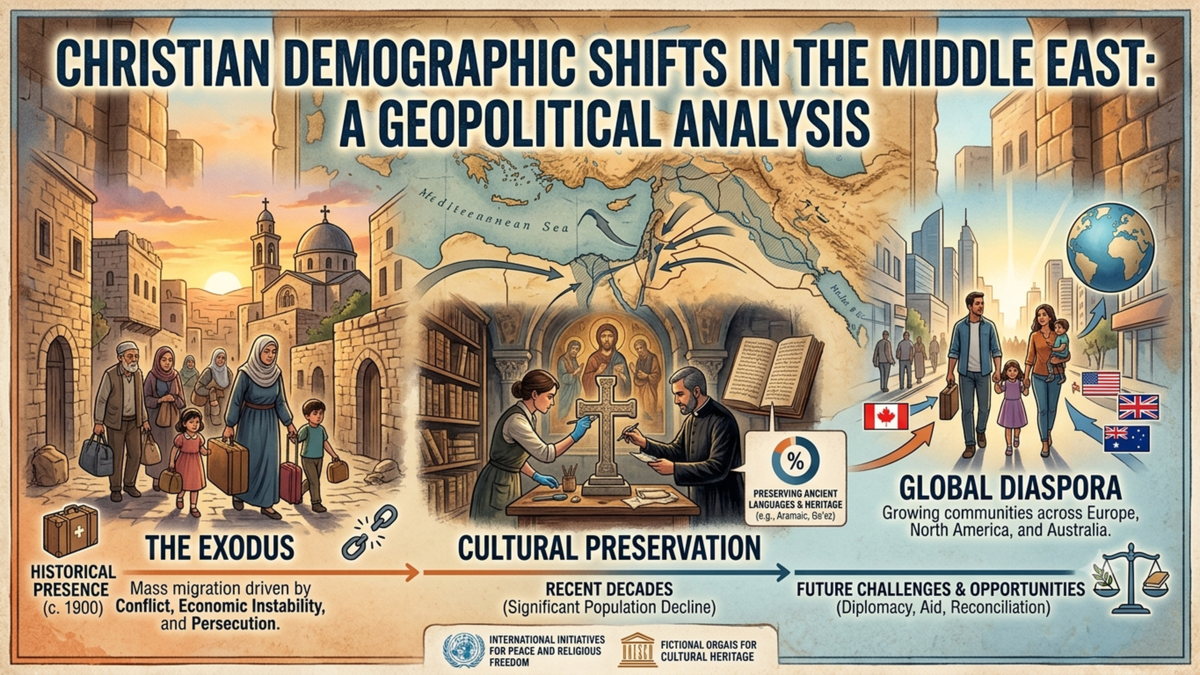
War, political instability, economic difficulties, emigration, persecution in certain contexts and changing social conditions have contributed to the decline of Christian populations in several parts of the Middle East.
At the same time, Christianity has not simply disappeared from the region. Churches, monasteries, schools, cultural institutions and diaspora communities continue to preserve traditions that are centuries — and in some cases nearly two millennia — old.
The demographic transformation therefore represents more than a population story. It has become a geopolitical, cultural and historical issue.
1. Christianity’s Ancient Roots in the Middle East
Christianity originated in the eastern Mediterranean during the first century.
Some of the earliest Christian communities developed in places that are now associated with modern-day Israel and Palestine, Syria, Lebanon, Jordan and Egypt.
The region became home to diverse Christian traditions, including:
- Coptic Christianity
- Syriac Christianity
- Maronite Christianity
- Armenian Christianity
- Greek Orthodox Christianity
- Assyrian traditions
- Chaldean Christianity
- Melkite Christianity
These communities developed their own liturgical traditions, languages, architecture and cultural practices.
Languages such as Syriac and Coptic are particularly important because they preserve elements of the ancient Christian heritage of the region.
2. The Demographic Transformation
During much of the modern era, several Middle Eastern countries experienced substantial Christian emigration.
The reasons were not identical everywhere.
Major factors include:
Political instability:
Periods of political upheaval and authoritarian rule affected different religious and ethnic communities in different ways.
Economic pressures:
Limited employment opportunities and economic crises encouraged many young people to seek education and employment abroad.
Armed conflicts:
Wars in countries such as Lebanon, Iraq and Syria caused displacement of millions of people, including Christians.
Religious persecution and sectarian violence:
In some locations, extremist violence and sectarian conflict directly targeted Christian communities and religious institutions.
Migration opportunities:
Growing Christian communities in North America, Europe and Australia created networks that made further migration easier.
It is important, however, not to reduce every Christian demographic change to religious persecution. Economic, political and security factors often overlap.
3. The Exodus and the Growth of the Diaspora
One of the most important consequences of Middle Eastern Christian migration has been the growth of Christian communities outside the region.
Today, significant Middle Eastern Christian populations can be found in countries including:
- United States
- Canada
- Australia
- France
- Germany
- Sweden
- United Kingdom
- Brazil
- Argentina
These diaspora communities often maintain connections with their ancestral homelands through churches, cultural associations, language programs and charitable organizations.
The diaspora therefore represents both a consequence of demographic change and a potential source of support for communities that remain in the Middle East.
4. Cultural Preservation: More Than Religion
The decline of a local Christian population can also affect the preservation of languages, manuscripts, architecture, music and traditions.
For example, Syriac Christian communities have preserved a rich literary and liturgical tradition.
Historic churches and monasteries also provide evidence of the region’s long Christian history.
Preserving these traditions is therefore not simply about preserving religious buildings. It can also mean preserving:
language, historical memory, manuscripts, architecture and cultural identity.
Digital archives, academic research, museums and diaspora organizations can play an increasingly important role in this process.
5. Christianity and Middle Eastern Geopolitics
The demographic transformation of Middle Eastern Christian communities also has geopolitical implications.
Christian communities have historically existed between different political, ethnic and religious groups. Their presence has sometimes made them important participants in national politics and civil society.
Their migration can consequently change the social composition of particular cities and regions.
For policymakers, the question is not simply:
“How many Christians remain?”
It is also:
“What happens to a society when one of its historic communities becomes significantly smaller?”
This raises questions about pluralism, minority rights, cultural heritage and national identity.
6. The Role of Conflict
The wars and political crises of recent decades accelerated demographic changes in several countries.
Iraq
The 2003 invasion and subsequent instability contributed to large-scale emigration among Iraqi Christians. The rise of ISIS later produced another major wave of displacement, particularly affecting Christian communities in northern Iraq.
Syria
The Syrian civil war displaced millions of people. Christian communities were among those affected by the conflict, although the scale and nature of impact varied considerably between regions.
Lebanon
Lebanon remains one of the Middle East’s most religiously diverse countries. However, civil war, political instability, economic crises and emigration have affected its Christian population and broader demographic balance.
These cases demonstrate why demographic statistics should always be examined alongside political and economic history.
7. The Future of Middle Eastern Christianity
The future is not necessarily a simple story of disappearance.
Several possibilities exist.
Preservation within the region
Churches and Christian organizations continue to operate across the Middle East. In some locations, communities are actively investing in education, social services and cultural preservation.
Diaspora engagement
Christian communities abroad can support their ancestral communities through humanitarian assistance, education, cultural projects and investment.
Heritage preservation
Ancient churches, monasteries, manuscripts and archaeological sites can be preserved through cooperation between governments, religious institutions and international heritage organizations.
Changing demographics
The demographic future will depend on factors including political stability, economic opportunity, security, birth rates and migration.
8. Why This Matters Beyond Christianity
The demographic transformation of Middle Eastern Christianity is relevant even to people who are not Christian.
Why?
Because the Middle East is not simply a collection of modern political borders. It is a region shaped by thousands of years of overlapping civilizations, religions, languages and cultures.
When an ancient community becomes smaller or leaves a particular region, the consequences can extend beyond religious demographics.
It can affect:
- Cultural heritage
- Local economies
- Historical sites
- Languages
- Political representation
- Social diversity
- Regional identity
- International relations
Understanding these changes therefore requires looking beyond religious statistics.
Conclusion
The demographic transformation of Middle Eastern Christian communities is one of the region’s most important but often misunderstood historical developments.
Migration, economic pressures, political instability, armed conflict and religious persecution have all played roles in different countries and periods.
Yet the story is not simply one of decline.
Millions of people with Middle Eastern Christian heritage now form communities around the world, while churches and cultural institutions continue to preserve ancient traditions in the region itself.
The future of Middle Eastern Christianity will therefore depend on two interconnected questions:
Can historic Christian communities maintain a sustainable presence in their ancestral homelands?
And:
Can the global Christian diaspora help preserve the cultural and historical heritage of these communities?
The answers will have implications not only for Christianity but also for the broader question of pluralism, cultural heritage and the geopolitical future of the Middle East.