




14 November in History: The Edict of Emperor Theodosius II and the Legacy of Christian Persecution of Pagans and Indigenous Cultures
Introduction
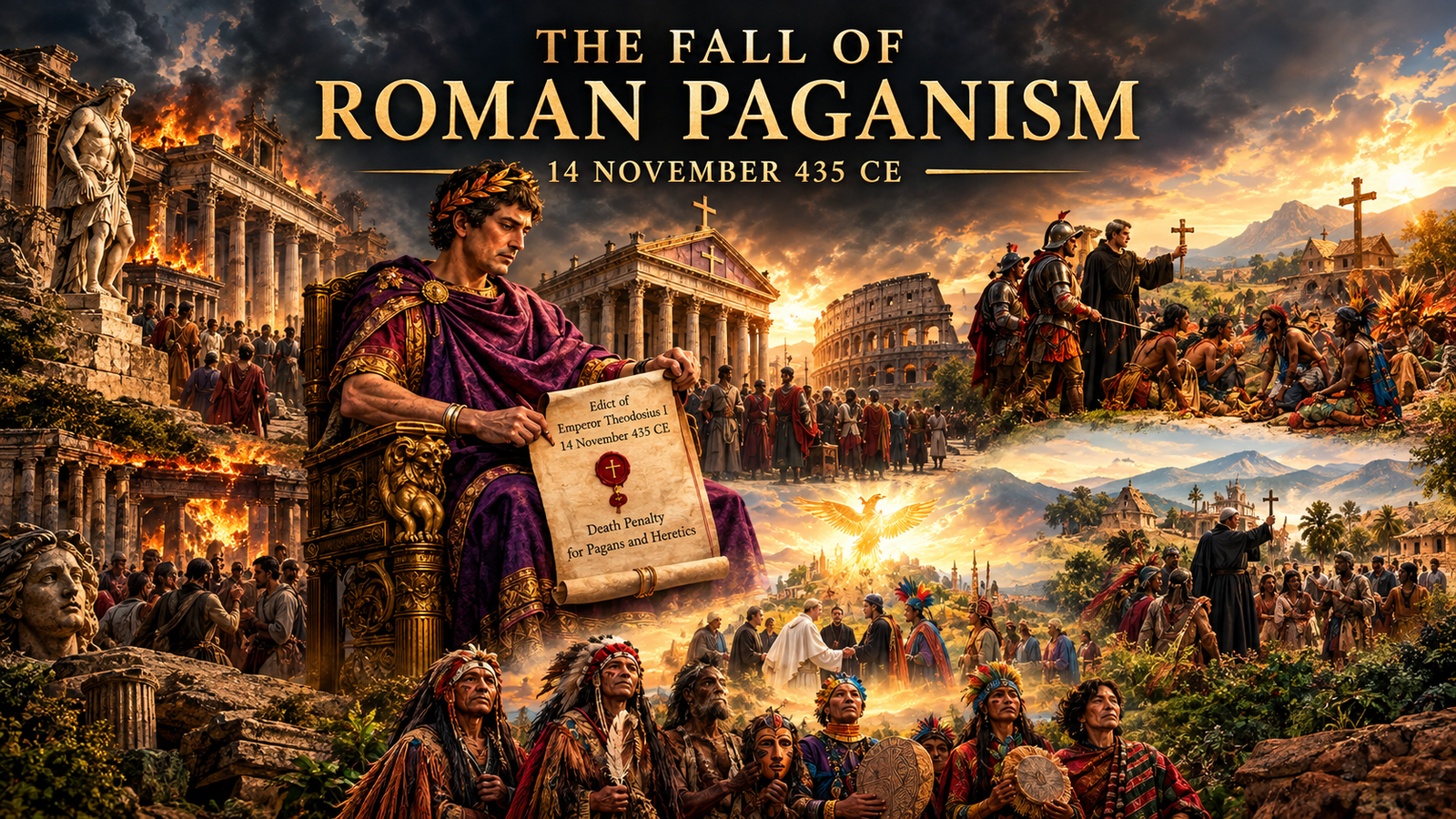
November 14 marks a dark yet pivotal moment in the history of religious intolerance, as the Roman Emperor Theodosius II issued an edict in 435 CE that sanctioned the death penalty for heretics and pagans within the Roman Empire. This decree was part of a larger legislative campaign by the Roman state to enforce Christian orthodoxy and eradicate alternative religious practices. Theodosius II’s edict represented a severe consolidation of power between the Roman state and the Christian church and laid a foundation for religious persecution that would extend beyond the bounds of the Empire and across centuries.
This article will examine the implications of Theodosius II’s edict, the persecution it fueled within the Empire, and the extended history of Christian missions against indigenous cultures in America, Australia, South America, and Africa. Through these conquests, the church often disregarded and dismantled local traditions and beliefs, leaving profound social, cultural, and spiritual scars on indigenous societies.
The Background to Theodosius II’s Edict
The Emperor Theodosius II, who ruled from 408 to 450 CE, is best known for codifying Roman law and for his efforts to establish Christian orthodoxy across his realm. As a devout Christian, he and his predecessors believed that political stability could only be achieved through religious uniformity. Thus, various laws were enacted under his reign to suppress pagan practices, eventually criminalizing paganism entirely.
On November 14, 435 CE, Theodosius II issued an edict declaring the death penalty for anyone found practicing paganism or heretical forms of Christianity. This act did not just target heretics—individuals holding unorthodox Christian beliefs—but extended to those adhering to the traditional Roman pantheon or other forms of indigenous spirituality. Although the edict theoretically targeted all non-Christians, its practical
effect was to eradicate the remaining elements of the once-vibrant polytheistic cultures within the Empire.
The Decline of Paganism in the Roman Empire
Paganism in Rome had been the cornerstone of its cultural identity for centuries. By the time of Theodosius II, however, Christianity had risen to a position of prominence, partly due to earlier emperors like Constantine I, who converted to Christianity and issued the Edict of Milan in 313 CE, allowing Christians to practice their faith openly.
Despite the spread of Christianity, pagan practices continued to thrive in some pockets of the Empire. In response, Theodosius I, the grandfather of Theodosius II, issued the Edict of Thessalonica in 380 CE, making Nicene Christianity the official religion of the Roman Empire and criminalizing paganism. Theodosius II’s edict in 435 CE escalated the severity of punishment from fines and imprisonment to the death penalty, marking one of the final blows to public pagan worship in Rome. This persecution led to the gradual disappearance of temples, shrines, and sacred sites, as they were either destroyed or converted into churches. Pagan intellectuals faced threats to their lives, and their works were often censored or destroyed, leaving a notable void in cultural and philosophical thought within the Empire.
The Broader Impact of Christian Intolerance: Global Colonization and Indigenous Suppression
Theodosius II’s edict was part of a broader trend of Christian intolerance toward pagan beliefs, a legacy that extended far beyond the boundaries of the Roman Empire. When European explorers and colonizers arrived in the Americas, Australia, Africa, and South America, they brought with them not only military force but also a mandate to convert indigenous populations to Christianity. Often, this goal was pursued at the cost of indigenous lives, beliefs, and traditions, resulting in profound cultural and spiritual loss.
A. The Americas
In the Americas, the arrival of Spanish and Portuguese colonizers in the late 15th and early 16th centuries marked the beginning of systematic oppression of indigenous populations. The church’s policy of “spiritual conquest” led to the forced conversion of indigenous people to Christianity. Conquistadors and missionaries destroyed indigenous temples, banned local rituals, and punished native religious leaders.
The Spanish colonial authorities worked hand-in-hand with the Catholic Church to replace indigenous belief systems with Christian teachings. This resulted in the cultural erasure of civilizations like the Aztec and Inca, who lost much of their history and traditions. Indigenous resistance to these conversions was often met with brutal violence, while those who adopted Christianity were expected to abandon their cultural heritage entirely.
B. Australia
In Australia, British colonization beginning in 1788 brought Christian missionaries intent on “civilizing” Aboriginal Australians. Aboriginal spirituality, which is deeply connected to the land and ancestral heritage, was dismissed by missionaries as “pagan” and incompatible with Christian teachings. Many sacred sites, central to Aboriginal beliefs, were desecrated or destroyed to make way for European settlements and churches.
Aboriginal Australians faced forced removals, and children were separated from their families under policies intended to assimilate them into white Christian society—a traumatic legacy still felt today. Efforts to convert Aboriginal people to Christianity often came hand-in-hand with policies of cultural and racial superiority, ultimately undermining Aboriginal identity and religious traditions.
C. Africa
Africa’s complex spiritual traditions were also targeted by Christian missionaries and colonizers, especially in the 19th and 20th centuries. Traditional African religions, which varied across the continent, were often dismissed as “primitive” and “heathen” by European missionaries. Rituals, symbols, and even indigenous languages were actively suppressed as colonizers established Christian churches and schools to replace local traditions.
The church frequently collaborated with colonial governments in imposing new social structures that mirrored European values, disregarding and undermining Africa’s rich spiritual heritage. This led to the loss of many cultural practices and native identities, with many Africans being pressured to adopt Christianity under colonial rule.
D. South America
South American indigenous societies, such as the Incas, experienced similar suppression under Spanish rule. Catholic missionaries were tasked with the conversion of indigenous people, and they worked systematically to destroy idols, temples, and any signs of indigenous spirituality. Traditional healers, who played central roles in communities, were often persecuted as “witches” or “sorcerers.”
The church justified these actions as a means of “saving” indigenous souls, but the campaigns of forced conversion ultimately weakened indigenous identities and led to the near-total loss of pre-Columbian spiritual practices. Today, many indigenous communities in South America have worked to reclaim their heritage and revive aspects of their traditional spiritual practices.
Lasting Impacts and Contemporary Reconciliation Efforts
The legacy of Theodosius II’s edict and the broader history of Christian suppression of pagan and indigenous practices has had lasting effects on global cultural landscapes. Centuries of forced conversion, destruction of sacred sites, and cultural oppression have created a lasting rift between Christian institutions and indigenous communities. Many indigenous groups today continue to grapple with the loss of cultural identity and spiritual heritage, while also working toward reclaiming and reviving their ancestral practices.
In recent decades, there has been a growing movement within many Christian denominations to acknowledge past wrongs committed against indigenous peoples. Some churches have made efforts to apologize for the role they played in colonial oppression, while others have supported indigenous-led efforts to revive and protect traditional practices.
In Australia, for example, churches have participated in National Sorry Day, an event that commemorates the mistreatment of Aboriginal and Torres Strait Islander people. In North America, the United Church of Canada and other denominations have issued formal apologies for their involvement in residential schools and other policies that attempted to assimilate indigenous peoples. In South America and Africa, indigenous groups are increasingly asserting their rights to religious and cultural autonomy.
Conclusion
The November 14 edict by Emperor Theodosius II is a stark reminder of the lengths to which religious authorities have historically gone to enforce ideological conformity. The death penalty for pagans and heretics laid the groundwork for centuries of Christian intolerance that extended far beyond the Roman Empire, shaping colonial policies that devastated indigenous cultures worldwide. The church’s history of suppressing pagan beliefs and indigenous traditions has left deep scars, yet there are ongoing efforts to foster reconciliation and respect for cultural diversity. Today, as societies seek to redress these historical injustices, there is a growing appreciation for the resilience and revival of indigenous spiritual practices—a testament to the enduring strength of human cultural heritage even in the face of systematic oppression.
