





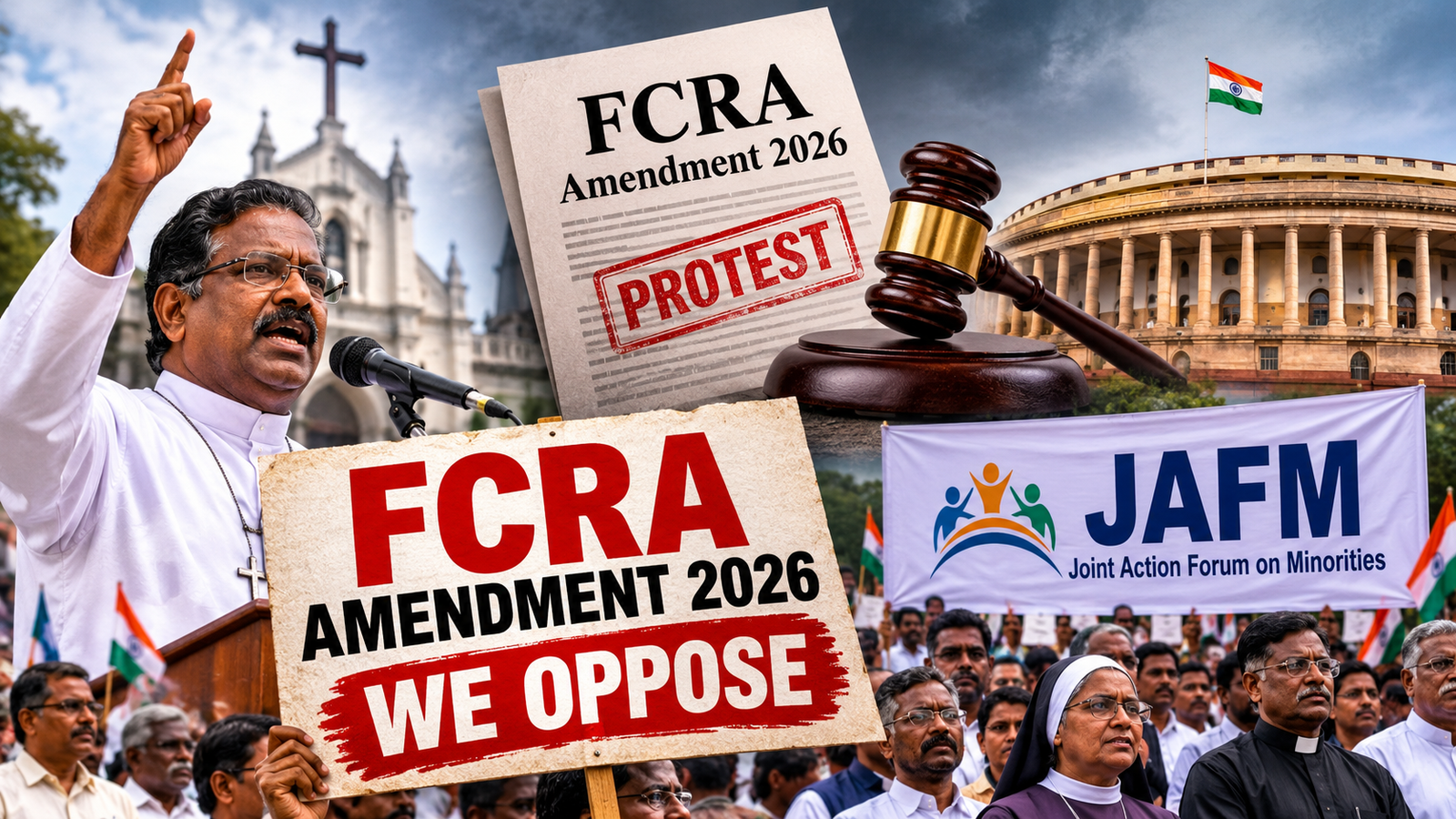
Nationwide Front Against FCRA Amendment 2026: How the Joint Action Forum on Minorities (JAFM) Built a National Protest Campaign
Special Report | Investigative Analysis
The proposed amendment 2026 to the Foreign Contribution (Regulation) Act (FCRA) has not only sparked a legal debate, but has also brought a section of minority organizations, church institutions, and civil society from across the country onto a common platform. Leading this protest is the Joint Action Forum on Minorities (JAFM)—a forum that has built a nationally coordinated campaign within just a few months.
Formed in May 2026, JAFM has adopted a multi-layered strategy stretching from Parliament to churches, civil society, social media, and public gatherings. Its public campaign is being led by DMK Rajya Sabha MP P. Wilson, who has toured various states to bring church leaders, social organizations, legal experts, and opposition parties onto a common platform.
What is at the center of the protest?
JAFM says the proposed amendment is not merely a matter of financial regulation. The forum claims that the new provisions could have a broad impact on the functioning of religious institutions, social organizations, and foreign-funded NGOs. On the other hand, the government says the amendments aim to strengthen transparency, accountability, and national security in foreign contributions.
According to the available document, JAFM is specifically objecting to the following provisions—provisions related to the management of assets upon cancellation of registration, the ₹10 lakh foreign contribution threshold, the use of the term “Proselytisation,” and provisions such as mandatory disclosure of social media and websites.
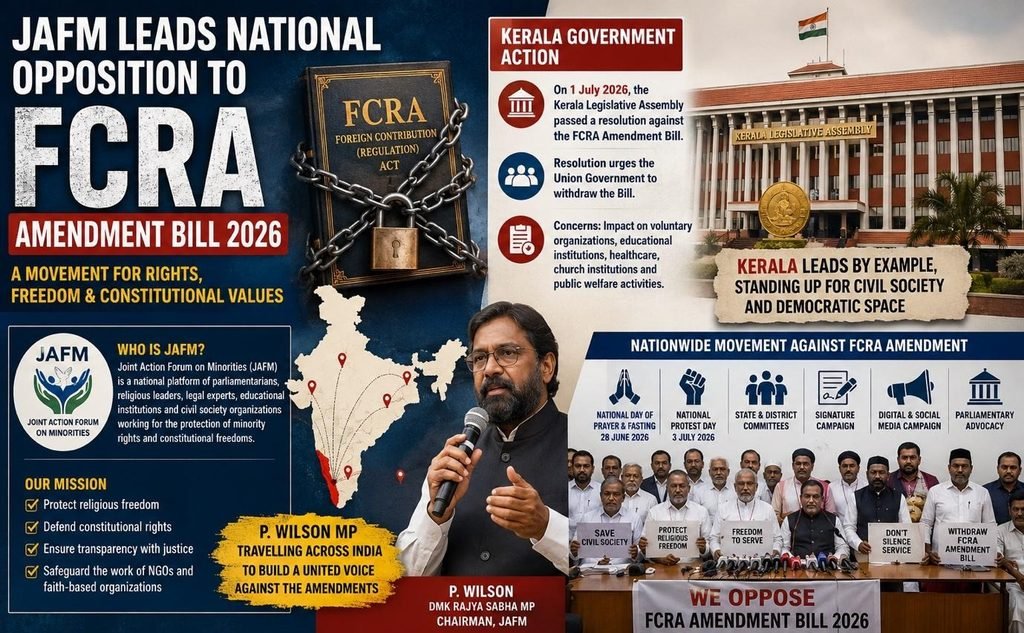
P. Wilson: The Face of the Campaign
The most prominent face of JAFM’s campaign is Rajya Sabha MP P. Wilson. After the forum’s formation, he began a series of consultation meetings, press conferences, and dialogue programs in various states. Chennai emerged as the strategic center of this campaign, where several important meetings and press conferences were held. The available document also mentions the press conference held in Chennai and JAFM’s active role.
From Churches to Digital Networks
JAFM did not limit the protest to memoranda alone. The forum developed a network of church institutions, educational institutions, legal experts, social organizations, and digital volunteers. A National Day of Prayer and Fasting was organized across the country on 28 June 2026, while subsequent phases plan a National Protest Day, formation of state and district committees, a signature campaign, and a social media campaign.
Strategy of the Protest
| Campaign | Objective |
|---|---|
| National Prayer and Fasting | Coordination among religious communities |
| State and District Committees | Building local organizational structure |
| Signature Campaign | Mobilizing public support |
| Memorandum to the Prime Minister | Conveying demands to the government |
| Digital and Social Media Campaign | Broad public awareness |
| Coordination with Opposition MPs | Raising the issue at the parliamentary level |
Which Provisions Are Most Disputed?
| Proposed Provision | JAFM’s Main Objection |
|---|---|
| Provisions related to asset management | Apprehension of impact on institutional autonomy |
| ₹10 lakh threshold | Impact on the survival of small organizations |
| “Proselytisation” | Legal ambiguity |
| Social media disclosure | Apprehension of broad surveillance |
| Additional administrative conditions | Increasing compliance burden |
Source: Available document.
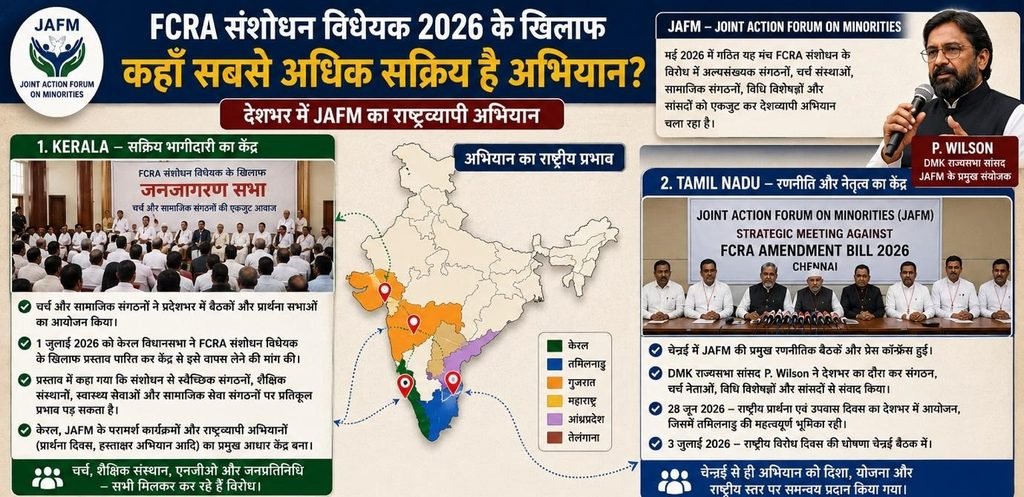
Where is the Campaign Most Active?
According to the document, Kerala and Tamil Nadu have emerged as the major centers of this campaign. The movement was given direction through strategic meetings in Chennai, while in Kerala, churches and social organizations showed active participation. In Gujarat, Maharashtra, Andhra Pradesh, and Telangana too, the administration noted the need to exercise caution from a law-and-order perspective.
What Next?
JAFM has announced a National Protest Day on 5 July 2026. The forum’s strategy is to advance organizational expansion to the state and district levels, public outreach campaigns, and parliamentary dialogue.
The ongoing debate on the FCRA Amendment 2026 is not limited to law alone. It has also become a subject of broader discussion on the role of civil society, religious freedom, regulation of foreign funding, and the balance with national security. The Joint Action Forum on Minorities (JAFM) has built an organized campaign in this debate and has sought to establish itself as the principal opposing forum to the proposed amendments. At the same time, the government’s position is that the proposed amendments have been brought with the objective of making the foreign contribution system more transparent, accountable, and secure.
In the coming parliamentary and public discourse, it will be important to see how a balance is established between these differing viewpoints through dialogue, the legislative process, and possible amendments.