
Date: 18 Dec. 2024 Category: Legal The Myth of Muslim Minority Status: Rethinking Legal and Social Realities India, with its diverse cultural and religious fabric, prides itself on being a secular democracy. Yet, the term “minority” often stirs heated debates, particularly when associated with Muslims, who are the second-largest religious group in the country. The […]
Date: 18 Dec. 2024
Category: Legal
The Myth of Muslim Minority Status: Rethinking Legal and Social Realities
India, with its diverse cultural and religious fabric, prides itself on being a secular democracy. Yet, the term “minority” often stirs heated debates, particularly when associated with Muslims, who are the second-largest religious group in the country. The designation of Muslims as a “minority community” continues to be questioned in terms of its validity and implications. This article explores whether Muslims truly qualify as a minority in India, the legal and constitutional frameworks governing minority benefits, and the distinction between minority appeasement and genuine welfare policies.
Understanding Minority Status in India
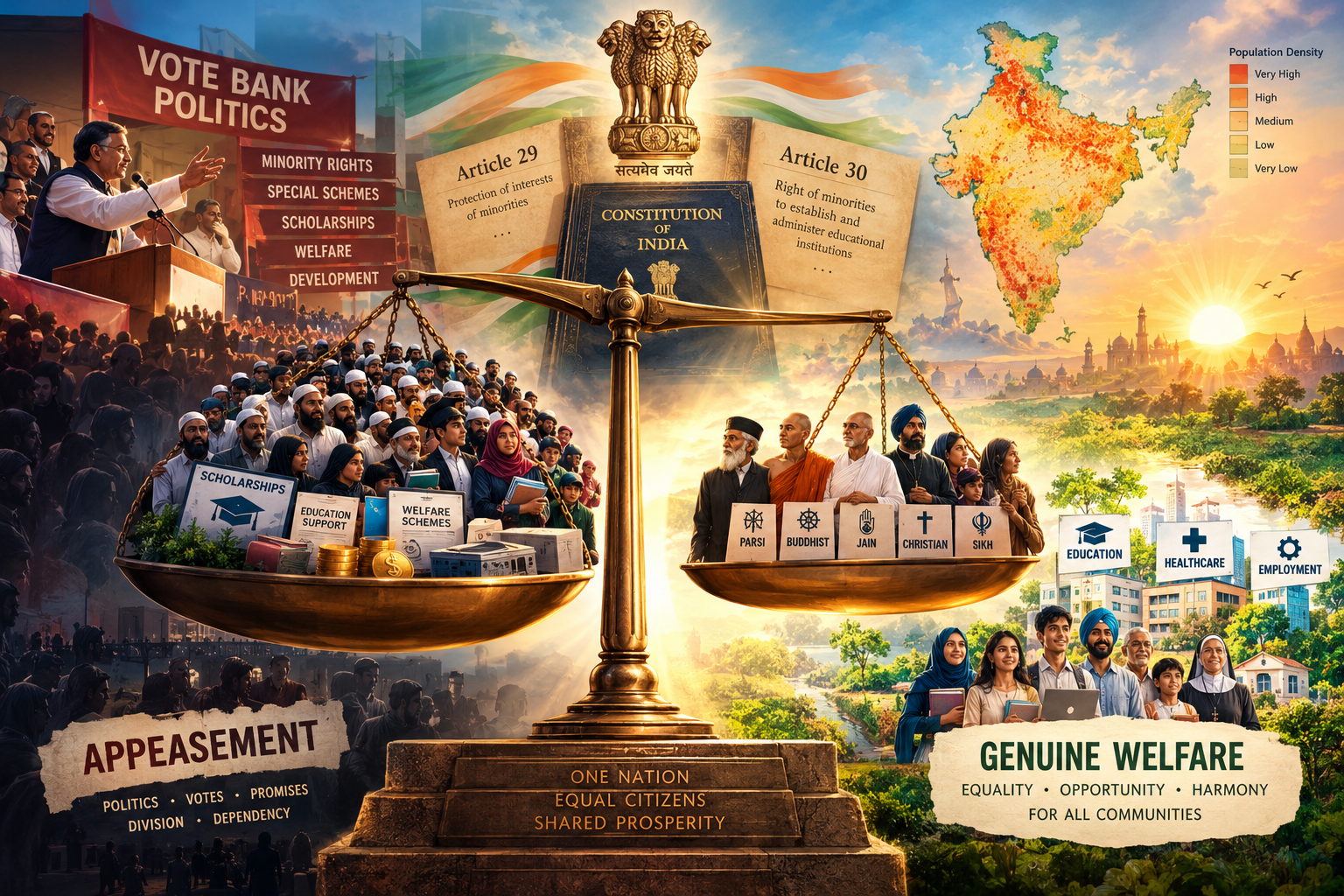
India’s Constitution provides safeguards for minorities under Articles 29 and 30. These provisions allow religious and linguistic minorities to preserve their culture and establish educational institutions. The National Commission for Minorities Act, 1992, identifies Muslims, Christians, Sikhs, Buddhists, Parsis, and Jains as minority communities. The criteria for this designation are largely based on population proportions and socio-economic indicators.
However, the designation of Muslims as a minority is contested because, numerically, they constitute approximately 14.2% of India’s population (Census 2011), making them the largest religious minority. In several states, Muslims outnumber other communities, raising questions about whether they meet the criteria of a vulnerable minority requiring special provisions.
Rejecting the Notion of Muslims as a Backward Community
The assumption that Muslims as a community are backward overlooks the complexities within the group. Socio-economic data indeed highlight disparities in education, employment, and access to resources among Muslims. However, attributing this to inherent backwardness risks oversimplification. Many Muslim-majority regions and communities demonstrate economic resilience, cultural vibrancy, and political influence.
The narrative of backwardness often perpetuates stereotypes and fuels policies that cater to identity politics rather than addressing genuine needs. It is critical to distinguish between systemic socio-economic challenges that affect individuals across all communities and the blanket labeling of an entire group as backward.
Muslims as a Minority: A Legal and Social Perspective
The legal recognition of Muslims as a minority has afforded them certain benefits, including educational scholarships, loans, and reserved seats in various institutions. However, these benefits are intended to uplift genuinely marginalized groups. Critics argue that Muslims, as a community, are no longer disadvantaged in ways that warrant such widespread affirmative action.
In regions where Muslims constitute a majority or wield significant political influence, the rationale for providing minority benefits becomes less tenable. States like Jammu & Kashmir (pre-reorganization), Kerala, and West Bengal highlight instances where Muslims have substantial demographic and political presence. The application of minority benefits in such contexts appears incongruent with their original intent.
The Debate on Benefits Cornered by Muslims
One of the most contentious issues is the perceived monopolization of minority benefits by Muslims, potentially at the expense of smaller, less visible minority groups like Parsis, Buddhists, and Jains. These groups often lack the demographic and political clout to assert their claims to government aid.
For instance, scholarships and welfare schemes intended for all minorities frequently see disproportionate enrollment by Muslims. While this may reflect better awareness or access within the community, it raises concerns about equitable distribution. Ensuring a balanced approach that considers the needs of all minorities, particularly smaller and historically marginalized ones, is essential for fostering social harmony.
Appeasement vs. Welfare: Drawing the Line
The distinction between minority appeasement and genuine welfare policies is both nuanced and significant. Welfare focuses on empowering individuals to overcome socio-economic barriers through education, healthcare, and employment opportunities. Appeasement, on the other hand, involves policies designed to secure political allegiance, often at the cost of broader social equity.
Policies that appear to favor Muslims disproportionately are often criticized as appeasement. For example, political promises of subsidies for religious pilgrimages or selective implementation of welfare schemes are viewed as pandering to a vote bank rather than addressing structural inequalities. This undermines the principle of secularism and risks alienating other communities.
Genuine welfare policies, however, transcend religious identities and target the most disadvantaged sections of society. Schemes like direct cash transfers, universal healthcare, and skill development programs benefit individuals irrespective of their religious affiliation. Such initiatives strengthen the social fabric and reduce the scope for communal tensions.
Rethinking the Legal Framework for Minorities
India’s approach to minority welfare needs a thorough reassessment. A more dynamic and region-specific understanding of minority status is crucial. For instance, Muslims may not qualify as a minority in states where they form a significant proportion of the population. Similarly, policies should prioritize socio-economic indicators over religious identity to ensure targeted intervention.
The legal framework should also address the disparities among minority groups. Smaller communities like Parsis and Buddhists require tailored policies that recognize their unique challenges. Introducing mechanisms to monitor and evaluate the distribution of minority benefits can ensure greater transparency and fairness.
A Call for Inclusive Policies
The debate over Muslims as a minority reflects broader concerns about identity politics and the equitable distribution of resources. Addressing these issues requires moving beyond the binary of majority versus minority. India’s diversity is its strength, but it also demands a governance model that prioritizes inclusivity and fairness.
Policymakers must focus on creating a level playing field where opportunities are determined by merit and need rather than religious identity. Programs that promote interfaith dialogue, shared cultural experiences, and collaborative community development can help bridge divides and foster mutual understanding.
Conclusion
Labeling Muslims as a minority while affording them extensive benefits raises complex legal, social, and political questions. While the intent behind minority welfare policies is noble, their implementation must reflect the realities of India’s diverse landscape. The focus should shift from appeasement to empowerment, ensuring that resources reach the most deserving individuals across all communities.
Ultimately, building a just and equitable society requires moving beyond divisive labels and embracing a vision of shared prosperity. Only then can India truly honor its commitment to secularism and social justice.